Introduction
In today’s competitive business environment, generating leads is only half the challenge. The real difficulty is converting those leads into paying customers while maintaining strong relationships with existing clients.
Many businesses still depend on spreadsheets, manual follow-ups, scattered emails, and disconnected software tools. These methods can result in missed opportunities, delayed responses, and inefficient sales processes.
AI-powered Customer Relationship Management (CRM) software is changing that.
In 2026, businesses are increasingly exploring artificial intelligence and automation to simplify daily operations, improve customer experiences, and make better decisions. AI agents and automated workflows are also gaining attention as companies look beyond basic chatbots toward more connected business processes.
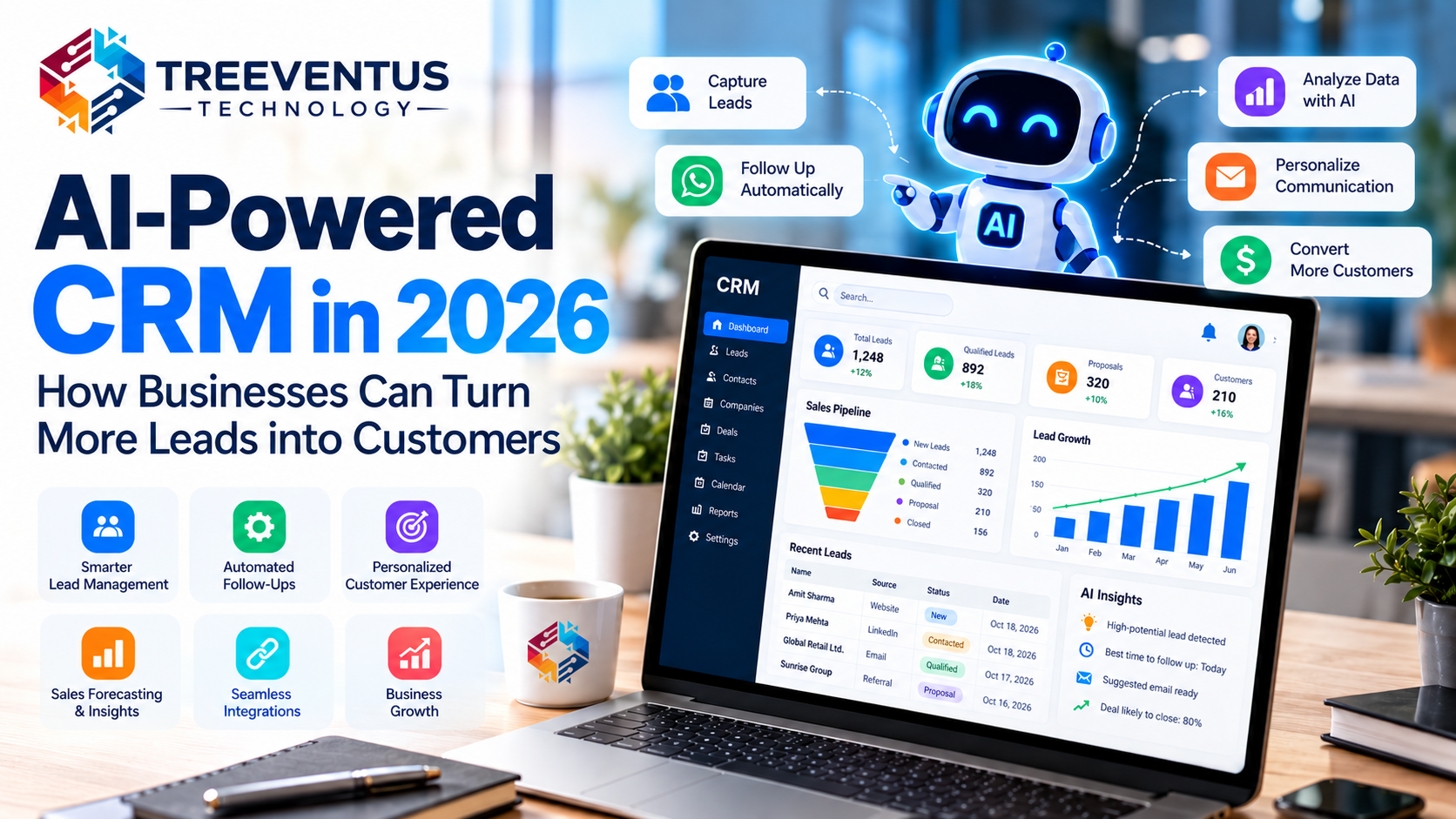
AI-powered CRM systems can help businesses organize customer information, prioritize leads, automate repetitive tasks, and give sales teams more time to focus on meaningful conversations.
What Is AI-Powered CRM Software?
AI-powered CRM software combines traditional customer relationship management features with artificial intelligence and automation.
A traditional CRM helps businesses store customer information, manage sales pipelines, record interactions, and track follow-ups. An AI-powered CRM can go further by analyzing available data, identifying patterns, suggesting next actions, and assisting with routine tasks.
Depending on its features and integrations, an AI-powered CRM can help businesses:
- Organize leads from websites, email campaigns, and other channels.
- Prioritize prospects based on their potential interest.
- Automate reminders and follow-up workflows.
- Generate summaries of customer conversations.
- Track sales performance through dashboards and reports.
- Provide AI-assisted responses to common customer questions.
The objective is not simply to collect more data. It is to help businesses use their data more effectively.
1. Smarter Lead Management
One of the biggest challenges for growing businesses is managing leads from multiple sources.
A company may receive enquiries through its website, social media, email, telephone calls, and advertising campaigns. When these enquiries are managed separately, some prospects may not receive timely attention.
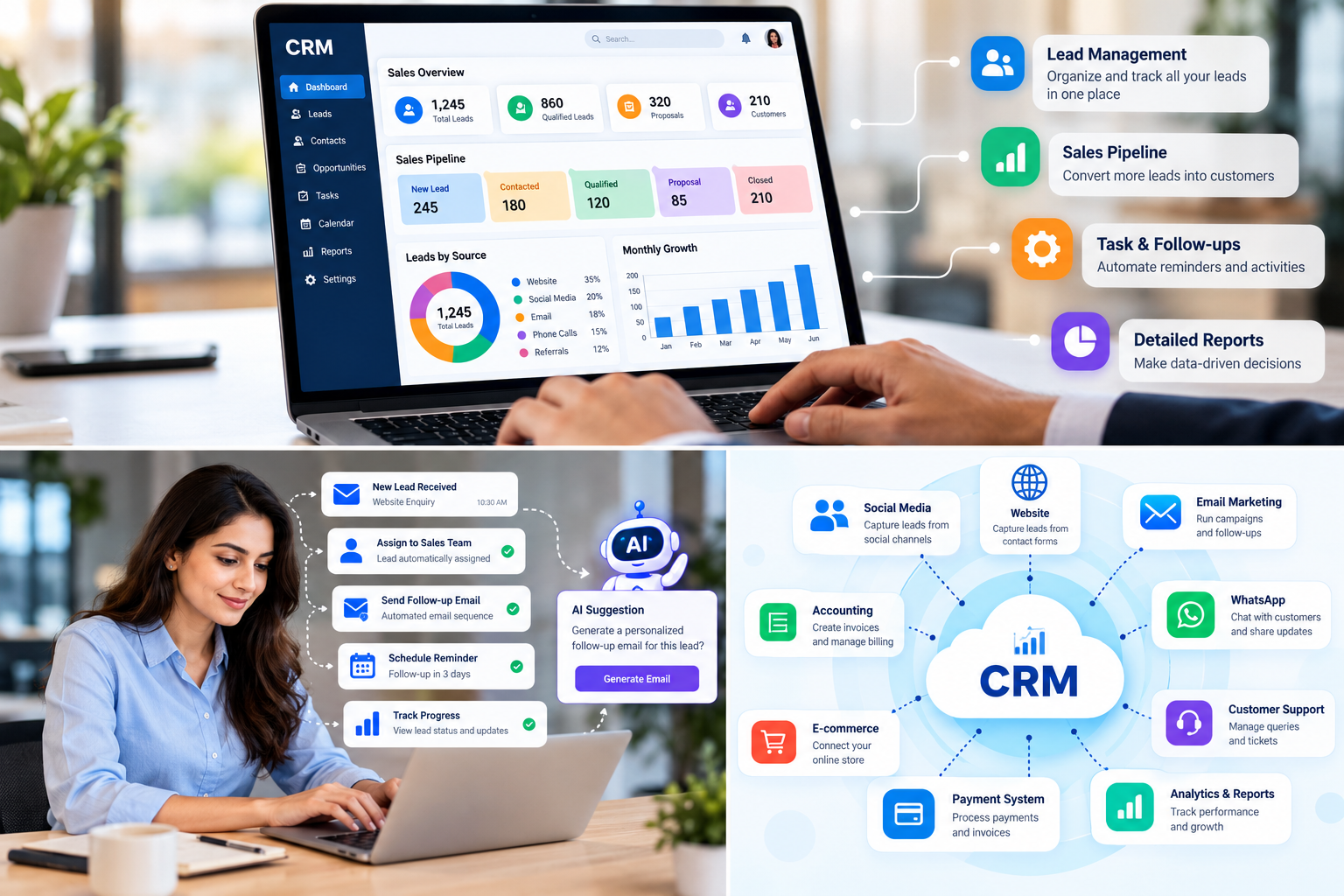
An AI-powered CRM can bring lead information into a centralized system and help sales teams manage the entire process.
For example, a software development company receiving 100 enquiries in a month can use CRM workflows to categorize prospects by service requirement, budget, location, and sales stage.
The sales team can then prioritize suitable opportunities instead of manually sorting every enquiry.
Business benefit: Better lead visibility, more organized sales activities, and fewer missed follow-ups.
2. Automated Follow-Ups That Save Time
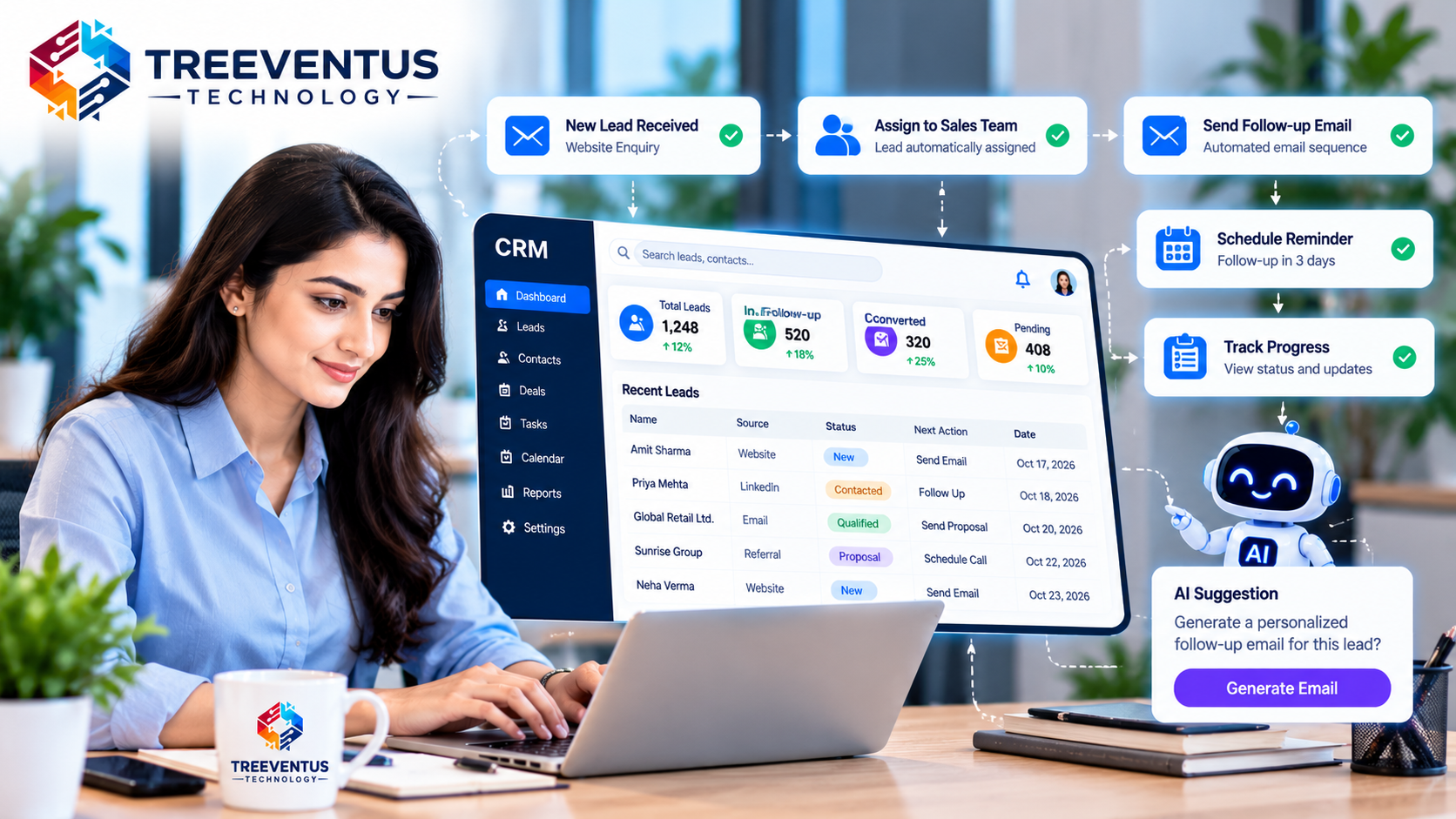
Automated CRM Workflow in Action
Following up with prospects at the right time can make a significant difference to the sales process.
However, sales representatives often handle multiple prospects simultaneously. Remembering every call, email, meeting, and pending response can become difficult.
CRM automation can help by scheduling reminders, assigning tasks, sending approved email sequences, and updating lead statuses according to defined rules.
For example, when a prospect submits a website enquiry, the CRM can assign the lead to a sales representative and create a follow-up task. If the prospect does not respond, another reminder can be scheduled.
AI can also assist in drafting personalized follow-up messages, which a team member can review before sending.
Businesses should configure these workflows carefully to ensure that communications remain relevant, accurate, and respectful of customer preferences.
Business benefit: Faster responses, consistent communication, and less manual administration.
3. Personalized Customer Experiences
Customers increasingly expect businesses to understand their requirements rather than send generic messages.
AI-powered CRM systems can help teams use previous interactions, service interests, and customer preferences to make communication more relevant.
For example, a customer who previously enquired about e-commerce website development may be interested in payment gateway integration, inventory management, or a custom CRM.
Instead of sending the same offer to every contact, the business can tailor its communication to the customer’s needs.
Personalization should always be based on appropriate, accurate customer information, with suitable privacy and data protection safeguards.
Business benefit: More relevant conversations, stronger customer relationships, and better opportunities for repeat business.
4. Sales Forecasting and Data-Driven Decisions
Many businesses make sales decisions based on assumptions rather than reliable information.
An AI-enabled CRM can analyze historical sales information and pipeline activity to help managers understand trends and identify potential risks.
Useful insights may include:
- Which marketing channels generate the most qualified leads.
- Which stages of the sales pipeline experience the most drop-offs.
- How long opportunities typically take to close.
- Which services receive the most enquiries.
- Which follow-up activities are associated with better conversion rates.
These insights can help management improve sales strategies and allocate resources more effectively.
However, forecasts are estimates, not guarantees. Their quality depends on the accuracy and completeness of the underlying data.
Business benefit: Better visibility into sales performance and more informed business planning.
5. Connecting CRM With Other Business Tools
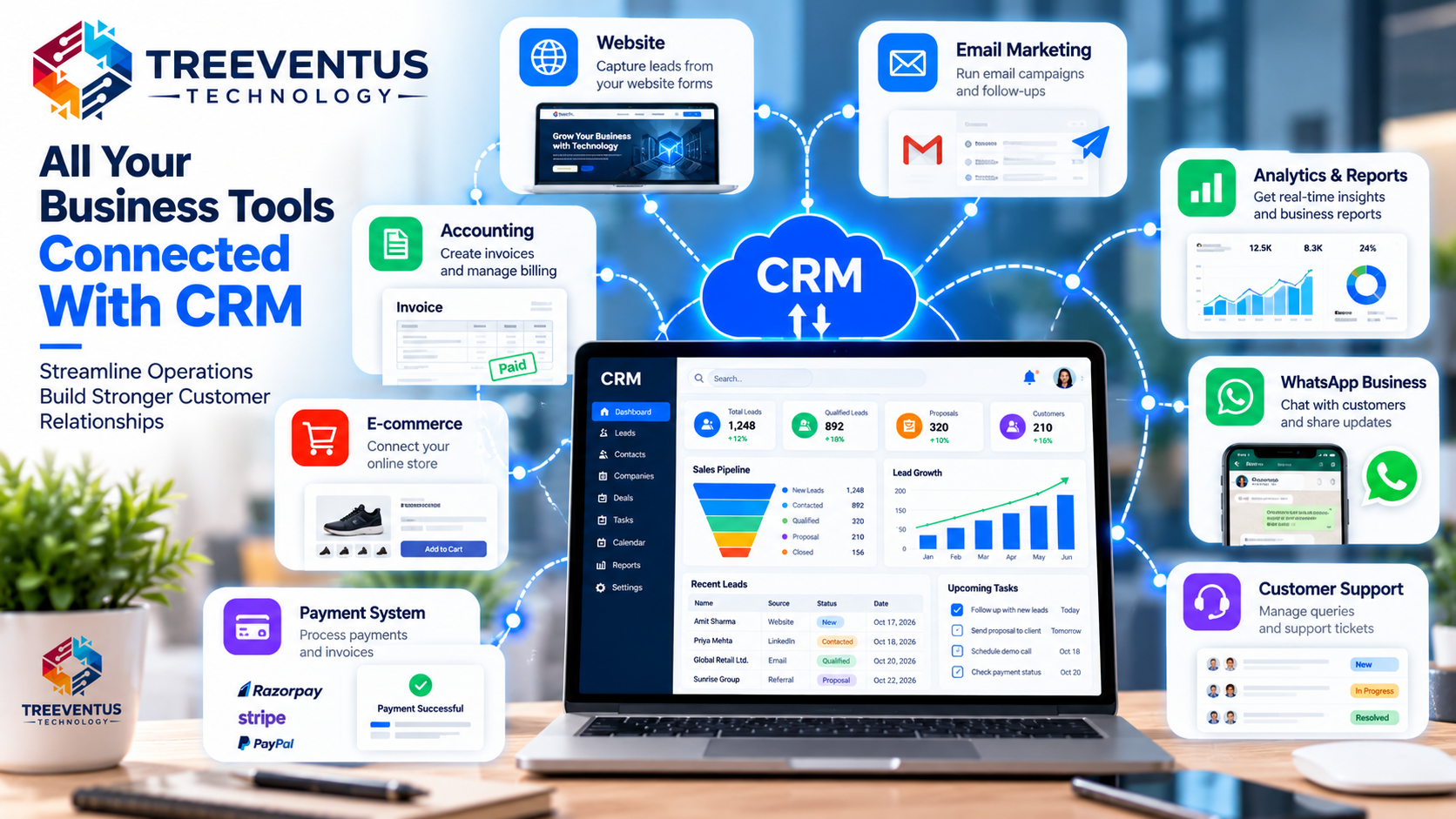
Connect your CRM with websites, email marketing, analytics, payment systems, e-commerce, and accounting software to streamline business operations.
A CRM becomes more useful when it can exchange information with the other tools a business already uses.
For example, a company may need to connect its CRM with:
- Its website and enquiry forms.
- Email marketing platforms.
- WhatsApp Business integrations where supported.
- Accounting and invoicing software.
- Customer support systems.
- Business analytics dashboards.
- E-commerce and payment systems.
When these systems work together, employees spend less time transferring information manually.
Custom API integrations can help businesses connect applications according to their operational requirements.
Before implementation, companies should evaluate integration costs, data security, access permissions, and ongoing maintenance requirements.
Business benefit: More connected workflows, fewer repetitive tasks, and better visibility across business operations.
6. Ready-Made CRM vs Custom CRM Development
Not every business needs a completely customized CRM. The right choice depends on the company’s size, budget, workflow, and future plans.
A ready-made CRM may be suitable for businesses that need standard contact management and sales tracking without extensive customization.
Custom CRM development may be a better option when a company has specific processes, complex approval systems, industry-specific requirements, or multiple applications that need to work together.
Consider these questions before choosing a solution:
- Can the software support your existing sales process?
- Does it integrate with your current business applications?
- Can you customize fields, permissions, reports, and workflows?
- Does the pricing remain reasonable as your team grows?
- How are customer data, backups, and access controls managed?
For some businesses, a hybrid approach works best: using an established CRM platform and adding custom integrations or automation where necessary.
The goal should be to solve real operational problems rather than purchase technology simply because it is trending.
7. How Small Businesses Can Get Started With AI-Powered CRM
Small businesses do not need to automate everything at once.
A practical starting point is to identify one process that consumes significant time or causes frequent mistakes.
Step 1: Identify the main problem. Determine whether your biggest challenge is lead tracking, follow-ups, reporting, customer support, or data management.
Step 2: Organize your data. Review existing spreadsheets, contact records, and customer information before moving them into a CRM.
Step 3: Automate one workflow. Start with a simple process, such as assigning new leads and creating follow-up reminders.
Step 4: Train your team. Ensure employees understand how to use the CRM and maintain accurate records.
Step 5: Measure performance. Track response times, follow-up completion, qualified leads, conversion rates, and administrative time.
Step 6: Expand gradually. Add AI assistance and more complex integrations only when they provide measurable value.
Businesses should also establish human review procedures, access controls, and clear rules for handling sensitive customer information.
The Future of AI-Powered CRM
AI is changing how businesses manage information and complete routine work. CRM platforms are evolving from simple contact databases into more intelligent systems that can support sales teams, automate workflows, and provide actionable insights.
As AI agents and connected applications mature, businesses may be able to coordinate more complex tasks across sales, customer service, marketing, and operations.
However, successful adoption will depend on more than technology alone. Clean data, well-defined processes, responsible AI use, employee training, and appropriate security measures will remain essential.
Businesses that begin with clear goals and expand automation thoughtfully can build systems that support long-term growth.
Conclusion
AI-powered CRM software offers businesses an opportunity to improve lead management, streamline follow-ups, personalize customer communication, and make more informed decisions.
Whether a company chooses a ready-made CRM, a customized solution, or a combination of both, the most important step is to select technology that addresses genuine business needs.
At Treeventus Technology, we help businesses explore digital solutions, including custom CRM development, AI-powered applications, web development, and business automation.
If your business is looking to simplify operations, connect its existing tools, or develop a CRM tailored to its workflow, the right technology strategy can help you move forward with greater confidence.
Ready to improve your business processes?
Visit https://treeventustech.com/ to explore our technology solutions and discuss your business requirements.