Artificial Intelligence is evolving rapidly. Businesses have already adopted AI chatbots, AI agents, and workflow automation. However, a major challenge still exists:
Most AI systems cannot securely access and interact with business software, databases, and tools without custom integrations.
This is where MCP (Model Context Protocol) Servers are changing the game.
In 2027, MCP Servers are becoming the standard way for AI applications to connect with CRM systems, ERP platforms, databases, cloud services, and enterprise software.
For businesses investing in AI transformation, understanding MCP could be the difference between isolated AI tools and truly intelligent business automation.
What Is an MCP Server?
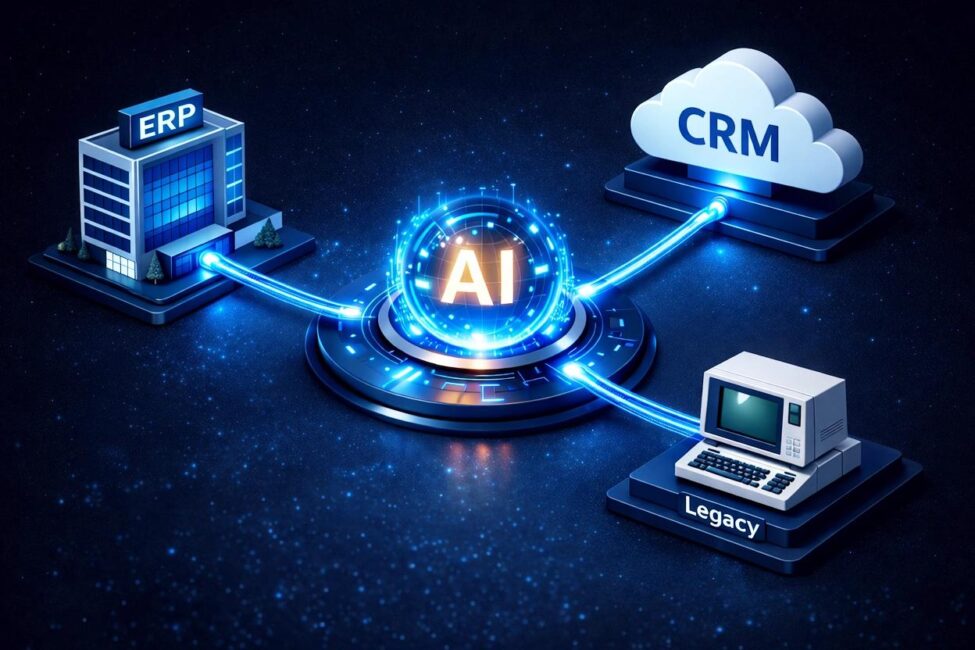
An MCP Server acts as a bridge between AI models and business systems.
Instead of building separate integrations for every application, MCP creates a standardized communication layer that allows AI systems to securely access information and perform actions.
Think of it like this:
Without MCP
- AI works alone
- Limited business context
- Manual workflows
- Multiple custom integrations
With MCP
- AI accesses business data
- AI interacts with software tools
- Automated workflows
- Standardized integrations
Why MCP Servers Matter
Many companies currently use:
- Salesforce
- HubSpot
- Zoho CRM
- SAP
- Microsoft Dynamics
- Google Workspace
- Slack
- Internal Databases
The challenge is getting AI to work seamlessly across all these systems.
MCP solves this by providing a universal communication layer.
Common Business Problems MCP Solves
Customer Support
Without MCP:
Customer service teams manually search multiple systems.
With MCP:
AI instantly accesses customer history, orders, invoices, and support records.
Sales Automation
Without MCP:
Sales representatives switch between CRM, email, spreadsheets, and reporting tools.
With MCP:
AI can retrieve information, update CRM records, schedule meetings, and generate reports automatically.
HR Management
MCP-enabled AI can:
- Process employee requests
- Access HR records
- Generate reports
- Schedule interviews
All from a single interface.
How MCP Works


Step 1
User gives AI a task.
Example:
“Show me all high-value leads generated this month.”
Step 2
AI sends a request to the MCP Server.
Step 3
MCP securely communicates with CRM software.
Step 4
The CRM returns data.
Step 5
AI presents insights and recommendations.
The entire process happens within seconds.
Benefits of MCP Servers
Improved Productivity
Employees spend less time searching for information.
Better Decision-Making
AI has access to accurate business data.
Reduced Development Costs
Companies avoid building countless custom integrations.
Enhanced Security
Centralized access management improves compliance.
Faster AI Deployment
Businesses can launch AI-powered workflows much faster.
Industries That Will Benefit Most
Healthcare
- Patient management
- Appointment scheduling
- Medical records access
Finance
- Reporting
- Risk monitoring
- Data analysis
Logistics
- Fleet tracking
- Route optimization
- Shipment management
Retail
- Customer personalization
- Inventory management
- Order processing
Why Businesses Should Prepare Now
The future of AI isn’t just smarter models.
The future is smarter connectivity.
Organizations that connect AI with their business systems will gain:
- Faster operations
- Better customer experiences
- Improved efficiency
- Competitive advantages
Companies that fail to build these connections may struggle to unlock the full value of AI investments.
How Treeventus Technology Can Help
At Treeventus Technology, we help businesses build future-ready digital ecosystems through:
- Custom Software Development
- AI Solutions
- CRM Development
- API Integrations
- Cloud Solutions
- Business Automation
- Enterprise Application Development
Our team develops scalable integration solutions that help organizations connect AI technologies with their business operations.
Final Thoughts
MCP Servers are emerging as one of the most important technologies in the AI ecosystem.
As businesses move toward AI-powered operations, the ability to securely connect AI with software systems will become essential.
The organizations that embrace AI connectivity today will be better positioned for the next wave of digital transformation tomorrow.